
A consistent cleaning routine helps protect employee health, prevent downtime, and keep your office running smoothly—here’s the efficiency-first checklist every US office needs.
According to the CDC, illnesses spread in the workplace cost US employers an estimated $225 billion annually in lost productivity. A single sick employee touching a conference-room door handle can seed pathogens across dozens of high-touch surfaces before lunch. Yet most offices don’t have a dirty problem—they have an inconsistent problem. Without a repeatable, documented process, cleaning becomes reactive: messes get addressed, spills get mopped, but the daily microbial load quietly rebuilds.
This guide gives you a practical office cleaning checklist engineered for efficiency. You’ll get daily, weekly, monthly, and quarterly task breakdowns with time estimates, a complete supplies list, staffing and zoning strategies, quality-control methods, and a copy-ready template you can print or drop into Google Docs. Whether you manage a 10-person startup or a 500-seat corporate floor, these principles scale—and they align with current US workplace sanitation norms, including EPA and OSHA-relevant guidance.
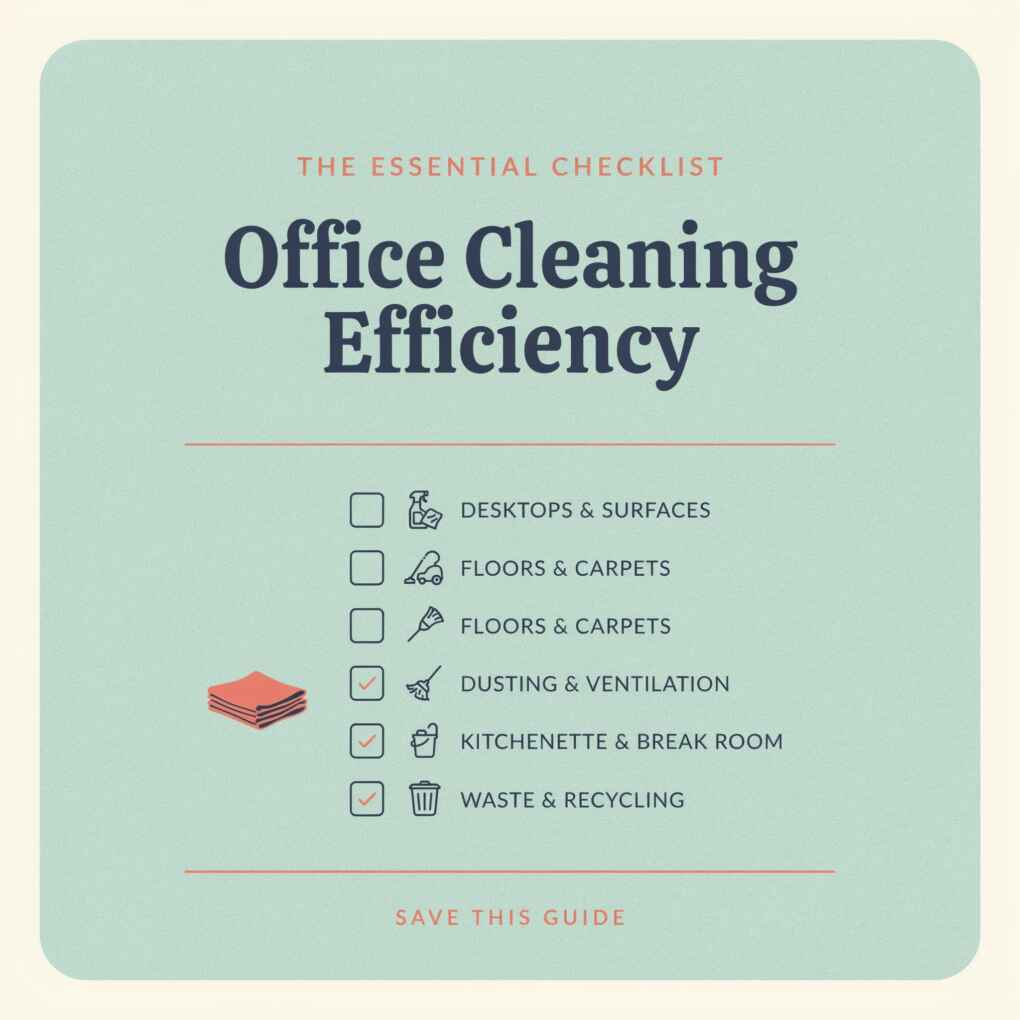
Why Efficient Office Cleaning Matters
Click to expand the four core reasons an efficient cleaning program pays for itself
1. Health and Hygiene
Pathogens like rhinovirus, influenza, and norovirus can survive on hard surfaces for hours to days. High-touch surface cleaning—doorknobs, shared keyboards, elevator buttons—is the single most effective way to break the chain of transmission. Reducing surface bioburden directly correlates with fewer sick days.
2. Productivity and Morale
A 2024 Staples workplace survey found that 88% of employees said a clean office environment meaningfully affected their job satisfaction. Cluttered, dusty, or visibly soiled workspaces increase cognitive load and decrease focus.
3. Safety and Compliance
While OSHA does not prescribe a single cleanliness standard for general offices, OSHA’s General Duty Clause and specific standards (e.g., 29 CFR 1910.22 for walking-working surfaces, 1910.141 for sanitation) require employers to maintain safe, sanitary conditions. Slip-and-fall incidents, blocked egress from clutter, and hazardous chemical storage are all compliance risks.
4. Cost Considerations
Preventive cleaning is dramatically cheaper than reactive deep cleans. A $400/month routine janitorial contract typically prevents the $3,000–$8,000 bill of an emergency biohazard remediation or a full carpet extraction after neglect.
Core Principles of Efficient Office Cleaning
Before diving into the checklist itself, six principles separate high-performing cleaning programs from chaotic ones:
- Prioritize high-touch and high-traffic areas. Door handles, light switches, elevator buttons, shared printers, kitchen faucets, and restroom fixtures accumulate microbes fastest. An 80/20 mindset—80% of hygiene risk lives on 20% of surfaces—keeps effort focused where it matters.
- Standardize with checklists. A written janitorial checklist eliminates variability between shifts, cleaners, and vendors. If a task isn’t on the list, it doesn’t reliably get done.
- Batch tasks and use zoning. Group similar tasks (all glass work, all restroom work, all floor work) and assign each cleaner a defined zone. This reduces equipment changes, walking time, and “who was supposed to do that?” confusion.
- Right-size staffing to foot traffic. A 5,000 sq ft office with 30 employees needs a very different cleaning frequency for office tasks than a 5,000 sq ft call center with 120 employees. Match frequency to actual usage, not square footage alone.
- Use the right tools. Microfiber cloths capture 99% of bacteria vs. 30% for cotton rags. HEPA-filter vacuums trap fine particulate instead of recirculating it. EPA List N-approved disinfectants are validated against specific pathogens.
- Choose green options where effective. Green cleaning for offices—using certified products like those carrying the EPA Safer Choice or Green Seal label—reduces VOC exposure and allergy triggers without sacrificing sanitation.
The Essential Office Cleaning Checklist
How to read this section: Each task includes an estimated time range. These assume a mid-sized US office (~5,000–10,000 sq ft, 40–80 employees). Adjust proportionally for your space.
Daily Checklist
These tasks form the backbone of workplace sanitation and should happen every business day, typically after hours or during low-traffic windows.
Front desk and lobby
- ☐ Empty trash receptacles and replace liners (2–4 min per station)
- ☐ Wipe reception counter, guest sign-in tablet/pen, door handles (2–3 min)
- ☐ Spot-clean glass entry doors for fingerprints (2 min)
Common areas and high-touch zones
- ☐ Disinfect door handles, light switches, elevator buttons, stair railings (3–6 min per zone)
- ☐ Wipe shared equipment: printer touchscreens, copier buttons, shared keyboards/mice at hot-desks (4–8 min)
- ☐ Refill hand-sanitizer dispensers at entry points and common nodes (3–5 min)
Restrooms
- ☐ Disinfect sinks, faucets, toilet handles, flush valves, stall latches (5–10 min per restroom)
- ☐ Replenish soap, paper towels, toilet paper, seat-cover liners (3–5 min)
- ☐ Mop floors with EPA-approved disinfectant solution (8–12 min per restroom)
- ☐ Empty sanitary and trash receptacles (3–5 min)
Kitchen and break room
- ☐ Wipe countertops, tables, microwave exterior, coffee station (5–10 min)
- p Empty trash and recycling; rinse bins if needed (3–5 min)
- ☐ Spot-mop spills (2–4 min)
Floors throughout
- ☐ Vacuum high-traffic carpet routes and sweep/mop hard floors (10–20 min depending on layout)
Conference rooms
- ☐ Straighten chairs, wipe table surfaces, clear leftover dishes/cups (5–10 min per room)
💡 Time-saving cleaning tip: Load a single janitorial cart with all daily supplies before starting. Every trip back to the supply closet costs 3–5 minutes of lost productivity.
Weekly Checklist
Weekly tasks address medium-frequency soil and dust accumulation. Schedule these on a consistent day (e.g., every Friday evening or Monday morning).
- ☐ Dust all horizontal surfaces: desks, shelves, file cabinets, window sills (10–20 min per zone)
- ☐ Dust air vents, return grilles, and ceiling-fan blades (10–15 min)
- ☐ Wipe monitors, desk phones, and keyboards using electronics-safe wipes and a documented employee desk cleaning policy that respects personal belongings (10–20 min per zone)
- ☐ Deep clean kitchen appliances: microwave interior, refrigerator (toss expired food per posted policy), dishwasher (15–30 min)
- ☐ Mop hard floors end-to-end and wipe baseboards in public areas (20–40 min)
- ☐ Clean interior windows, glass partitions, and conference-room walls (15–30 min)
- ☐ Empty and sanitize recycling bins; wipe lids and handles (5–10 min)
- ☐ Spot-check upholstered chairs for stains and treat as needed (5–15 min)
Monthly Checklist
Monthly work is the office deep cleaning checklist—preventive maintenance that keeps the space looking professional and extends the life of your furnishings.
- ☐ Deep-clean carpets via hot-water extraction or targeted spot treatment on high-traffic lanes (1–3 hours depending on area)
- ☐ High dusting: light fixtures, top of cabinets, crown molding, high vents (1–2 hours)
- ☐ Low dusting: baseboards, underside of desks, behind furniture (1–2 hours)
- ☐ Inspect and service equipment: replace vacuum HEPA filters, launder mop heads, test dispenser batteries (30–60 min)
- ☐ Audit and rotate stock of cleaning supplies for office use and PPE; discard expired products (30 min)
- ☐ Review and update cleaning logs; run a 15-minute training refresher with the team (30 min)
- ☐ Restock first-aid kits and AED pads (coordinate with safety officer) (15 min)
Quarterly and Annual Tasks
These fall on a longer cycle and often involve specialized contractors.
Quarterly
- ☐ Professional upholstery cleaning for lobby and conference seating
- ☐ Strip, scrub, and re-wax (or screen-and-recoat) hard-surface floors
- ☐ Exterior window washing (ground floor and accessible upper panes)
- ☐ HVAC filter replacement and duct inspection (coordinate with facilities)
Annually
- ☐ Full carpet extraction across the entire office
- ☐ Review safety and compliance policies against current OSHA guidance and local health codes
- ☐ Re-evaluate cleaning vendor contracts or in-house staffing levels
- ☐ Update the office cleaning plan based on space changes, headcount, or new regulations
Roles, Staffing, and Scheduling Tips
The best office cleaning schedule fails without clear ownership. Here’s how to structure it.
In-house vs. contracted janitorial
Small offices (under ~3,000 sq ft) often handle basics in-house and contract heavier work. Mid-sized and larger offices typically benefit from a dedicated janitorial contract. Hybrid models—internal day porter for spot cleaning plus an after-hours vendor for deep work—are increasingly popular.
Zoning for accountability
Divide your floor plan into 2–5 zones based on traffic patterns, not square footage. Assign one cleaner (or crew) per zone so accountability is unambiguous. Post a zone map in the janitorial closet.
Stagger timing to reduce disruption
- After-hours (6 PM–10 PM): Vacuums, floor scrubbing, restroom deep cleans
- Midday touch-ups (11:30 AM–1:30 PM): Restroom restocking, kitchen resets, lobby tidying
- Morning (6 AM–8 AM): Conference-room prep, glass work before employees arrive
Staffing rule of thumb
For daily maintenance, plan roughly 1 cleaner per 3,000–5,000 sq ft of standard office space, or about 1 cleaner per 40–60 employees, whichever yields the higher headcount. High-density spaces (call centers, open-plan coworking) skew toward the lower end of the range.
Cross-training
At least two team members should be trained on every zone. Absences shouldn’t strand a checklist.
Supplies and Equipment Checklist
Your office maintenance checklist is only as strong as its supply closet. Stock these essentials:
Click to see the full supplies and PPE list
Cleaning tools
- Microfiber cloths (color-coded by zone: e.g., red = restrooms, blue = general, green = kitchen, yellow = high-touch)
- Color-coded mop heads and buckets with wringers
- HEPA-filter backpack or upright vacuum
- Dual-chamber spray bottles (labeled)
- Squeegee for glass
- Extendable duster for high work
- Floor scrubber or auto-scrubber (for spaces > 10,000 sq ft)
Chemicals and consumables
- EPA List N-registered disinfectants (validated against pathogens of concern)
- Neutral-pH floor cleaner
- Glass cleaner (ammonia-free for tinted film)
- Stainless-steel polish (if applicable)
- Hand soap, paper towels, toilet paper, seat covers, trash liners
- Hand sanitizer (60%+ alcohol)
PPE
- Nitrile gloves
- Safety glasses for splash-risk tasks
- Slip-resistant shoes for staff
- N95 or equivalent during dusting or carpet extraction
Green alternatives
Where feasible, select products carrying EPA Safer Choice, Green Seal (GS-37), or UL Ecologo certification. These reduce VOC exposure—especially important for shared desks and employees with chemical sensitivities or asthma.
Quality Control and Documentation
Without cleaning quality control, a checklist is just a wish list. Build three layers of verification:
- Self-verification at the task level. Cleaners initial each completed task on a printed or digital commercial cleaning checklist after every shift.
- Supervisor spot checks. A weekly walkthrough with a simple 1–5 scoring rubric on 10–15 anchor surfaces (e.g., front-door handle, restroom mirror, kitchen counter). Apps like Swept, Connecteam, or even a shared Google Sheet work well.
- Occupant feedback loop. Post a QR code in restrooms and break rooms linking to a 30-second feedback form. Track incident response time (time from reported issue to resolution).
Metrics worth tracking
| Metric | Why it matters |
|---|---|
| Checklist completion rate | Measures consistency |
| Average incident response time | Measures agility |
| Supply-cost-per-sq-ft/month | Flags waste or under-staffing |
| Employee satisfaction (annual survey question) | Links hygiene to morale |
| Reported illness-related absences (aggregate) | Long-term health signal |
Quarterly reviews of these metrics make your office janitorial best practices genuinely data-driven rather than anecdotal.
Time-Saving Hacks and Efficiency Best Practices
Small process tweaks yield outsized time savings over a year:
- Batch by task type, not room. Do all glass, then all restrooms, then all floors. You change tools once instead of seven times.
- Pre-treat high-soil areas. Spray restroom fixtures and let disinfectant dwell for the label-specified contact time (usually 3–10 minutes) while you work on adjacent tasks.
- Use electrostatic sprayers for large spaces. For gym-adjacent offices, daycare-attached spaces, or post-illness events, electrostatic application cuts disinfecting time by 50–70%.
- Standardize supply locations. Every closet should be organized identically. New hires find what they need in seconds, not minutes.
- Follow the color-coded system religiously. The same cloth that wiped a restroom sink should never touch a break-room counter. This is both a hygiene and liability standard.
- Maintain equipment. A vacuum with a clogged filter takes twice as long and performs half as well. Schedule monthly filter/bag/brush maintenance.
Copy-Ready Template: Daily + Weekly Office Cleaning Checklist
Copy and paste the block below into Google Docs, Notion, or your preferred CMMS.
=== DAILY OFFICE CLEANING CHECKLIST ===
[ ] Empty trash & replace liners (2-4 min/station)
[ ] Disinfect door handles, light switches, elevator buttons (3-6 min/zone)
[ ] Wipe shared equipment (printers, keyboards, mice) (4-8 min)
[ ] Restroom: disinfect fixtures, mop, restock (5-10 min each)
[ ] Kitchen: wipe counters, tables, microwave, empty trash (5-10 min)
[ ] Vacuum/sweep high-traffic routes (10-20 min)
[ ] Conference rooms: straighten, wipe tables (5-10 min/room)
[ ] Refill hand-sanitizer dispensers (3-5 min)
Cleaner initial: ___   Date: ___

=== WEEKLY OFFICE CLEANING CHECKLIST ===
[ ] Dust desks, shelves, vents, window sills (10-20 min/zone)
[ ] Wipe monitors, phones, keyboards per desk policy (10-20 min/zone)
[ ] Deep clean kitchen appliances & fridge toss (15-30 min)
[ ] Full mop of hard floors + baseboard wipe (20-40 min)
[ ] Clean interior glass & partitions (15-30 min)
[ ] Sanitize recycling bins (5-10 min)
[ ] Spot-treat upholstered chairs (5-15 min)
Cleaner initial: ___   Date: ___
Frequently Asked Questions
How often should shared keyboards and mice be disinfected?
Daily during flu season or outbreaks; at minimum three times per week otherwise. Use electronics-safe wipes—never spray liquid directly onto devices.
What’s the difference between cleaning and disinfecting?
Cleaning removes visible dirt and organic matter with soap and friction. Disinfecting kills pathogens using an EPA-registered chemical. Best office disinfecting tips always start with cleaning first—disinfectants cannot penetrate a layer of grime.
Do we still need to follow COVID-19 cleaning guidelines?
Specific pandemic-era protocols have largely been folded into general office hygiene best practices. Still, maintaining a baseline of high-touch surface cleaning and hand-sanitizer access remains recommended by the CDC for respiratory-illness seasons. Always check current CDC/EPA updates for the latest protocols.
Closing: Make the Checklist Work for You
An efficient office cleaning program does three things simultaneously: it protects employee health, preserves your physical assets, and signals—every single day—that your organization takes its workplace seriously. The office cleaning checklist above isn’t a bureaucratic exercise; it’s the operating system for a healthier, more productive office.
Next steps:
- Print or copy the template in the section above and run it as-is for two weeks.
- Adjust time estimates to your actual square footage and headcount.
- Assign zones and owners—no task should live without a name attached.
- Review metrics monthly and iterate.
If you’d like, we can turn this checklist into a branded, one-page printable PDF for your janitorial closet or employee handbook—just reach out. And if your team has discovered a time-saving trick that isn’t on this list (a particular microfiber brand, a scheduling hack, a vendor-management tip), drop it in the comments. The best office cleaning plan is the one that keeps learning from the people who execute it every day.